
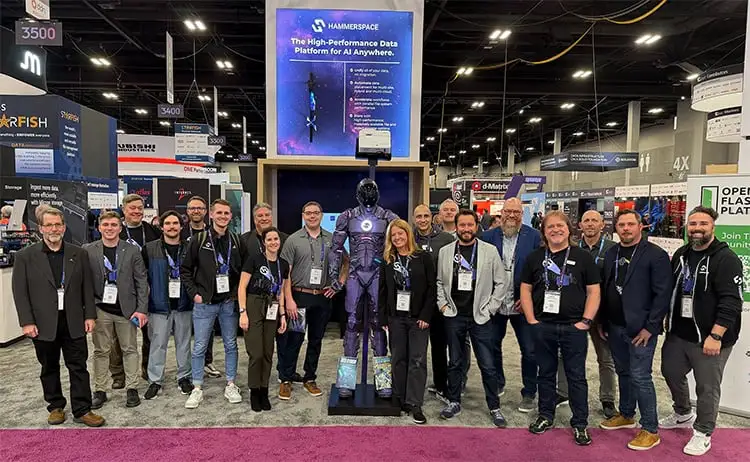
SC25 Insight: AI & HPC Have Officially Converged
And data, not compute, is the constraint.
Against this backdrop, Hammerspace emerged as a key player at Supercomputing in St Louis, enabling AI-scale data performance using the infrastructure organizations already have. These were the headlines and new resources from the show:
- New Data Platform Version 5.2 Release: Major boosts in performance, security, and ecosystem integration
- How Hammerspace Makes the Fastest Storage the Closest Storage
- Breakthrough IO500 10-Node Production result, establishing a new era for high-performance data infrastructure, with full details in our blog post “Samsung and Hammerspace Go To The Next Level In The IO500 Benchmark.”
- How we built the fastest NFS-based benchmark ever in the Data Unchained Podcast
Case Study
Hammerspace Reduces Vanderbilt ACCRE’s Storage Costs by 48%

Learn why Vanderbilt University selected Hammerspace to unify its storage infrastructure, reduce storage costs, and gain flexibility to deliver storage resources more to researchers in a more agile way.
“Hammerspace’s composable, open architecture lets us unify GPU, tiered, and archival storage into a single environment,” said Hunter Hagewood, Executive Director of Research Computing Operations at Vanderbilt University. “It’s dramatically reduced costs and transformed how we deliver compute and storage to our researchers.”
Awards

For the third year in a row, Hammerspace was recognized among the “Editors’ Choice: Top 5 New Products or Technologies to Watch” for outstanding efforts and accomplishments in HPC and AI, in the HPCwire Readers’ Choice Awards, presented at SC25.
“HPC and AI now rely on the same data and infrastructure,” said Molly Presley, SVP of Global Marketing at Hammerspace. “Our Data Platform eliminates silos and unifies data across on-prem, cloud, and edge so organizations can unlock existing data for advanced HPC and AI workloads without rebuilding their infrastructure.”
Download “Accelerating AI/ML Workloads” White Paper
Are I/O bottlenecks wasting valuable GPU cycles? Traditional networked storage wasn’t built for the intense demands of modern AI/ML. This performance analysis, conducted by a leading quantitative research firm, details a new approach. Hammerspace Tier 0 architecture delivered 4.4x more bandwidth and 56% lower latency for critical AI/ML workloads by activating local NVMe into a shared, high-performance tier.
Download our new whitepaper to learn how to design a storage architecture that can keep pace with your GPUs.
New AI Data Platform Demo Video
Check out our new demo of the Hammerspace AI Data Platform (AIDP), which accelerates AI using the infrastructure you already have; no new silos or overhauls. AIDP unifies all unstructured data across locations and automates tagging, placement, and embedding so AI pipelines always get the right data at the right time, delivering faster time-to-value, lower waste, and simpler operations.
Hammerspace Expansion to Power AI Infrastructure Growth Across Asia

Strengthening our expansion into one of the world’s fastest-growing AI markets, Angela Bai will lead Hammerspace’s operations, partnerships, and customer success strategy in China. “Angela’s deep market knowledge and leadership, combined with our Data Platform for AI, create a powerful foundation for our next phase of growth in China,” said Jeff Lebold, VP of Asia-Pacific.
UPCOMING EVENTS

Hammerspace will be at Gartner IOCS 2025 in Las Vegas (Booth #121), where Molly Presley will lead a Featured Session on Dec. 9: “Solving AI’s Hidden Bottleneck: Eliminating Data Fragmentation with an AI-Ready Platform.” She’ll share how the Hammerspace Data Platform, aligned with NVIDIA’s AI Data Platform, unifies enterprise data for GPU-speed access and faster AI pipelines.
Book a meeting at the show here.
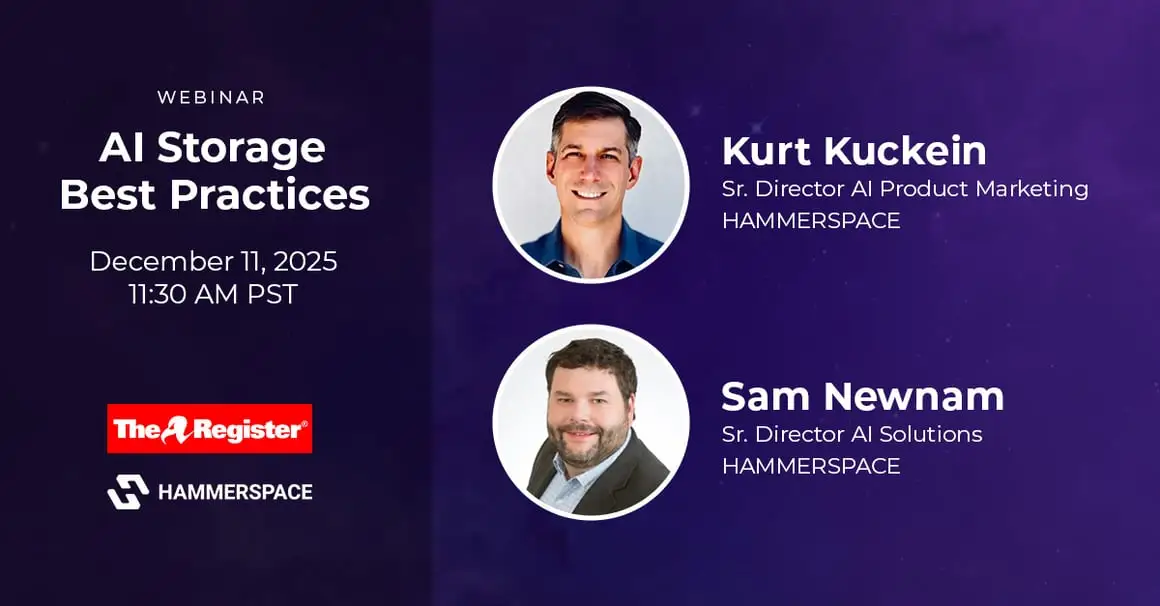
Register today to join Hammerspace and The Register on Dec. 11 for an information-packed webinar on AI Storage Best Practices. They’ll reveal the top three problems enterprises must solve to get to production AI and how to avoid AI wipe-outs. Find out what’s really slowing down your AI pipeline (hint: the way you store and move data is often the real choke point.)
