By Eric Bassier, Senior Director of Solutions Marketing & Sales Enablement
Hammerspace Data Orchestration solves key challenges for IT infrastructure teams like simplifying data governance by eliminating data copy sprawl, freeing up IT resources by automating manual processes, and enabling these teams to take full advantage of elastic cloud compute and storage resources.
Our data orchestration framework is depicted below. In a recent blog post, we focused on “Step 1” – explaining how Hammerspace eliminates data silos by consolidating data into a Global Data Platform that spans sites, clouds, and any storage system.
This week we’ll dig into “Step 2” – explaining how Hammerspace software automates data management, data movement, and data protection using plain-language policies that we call “objectives.”
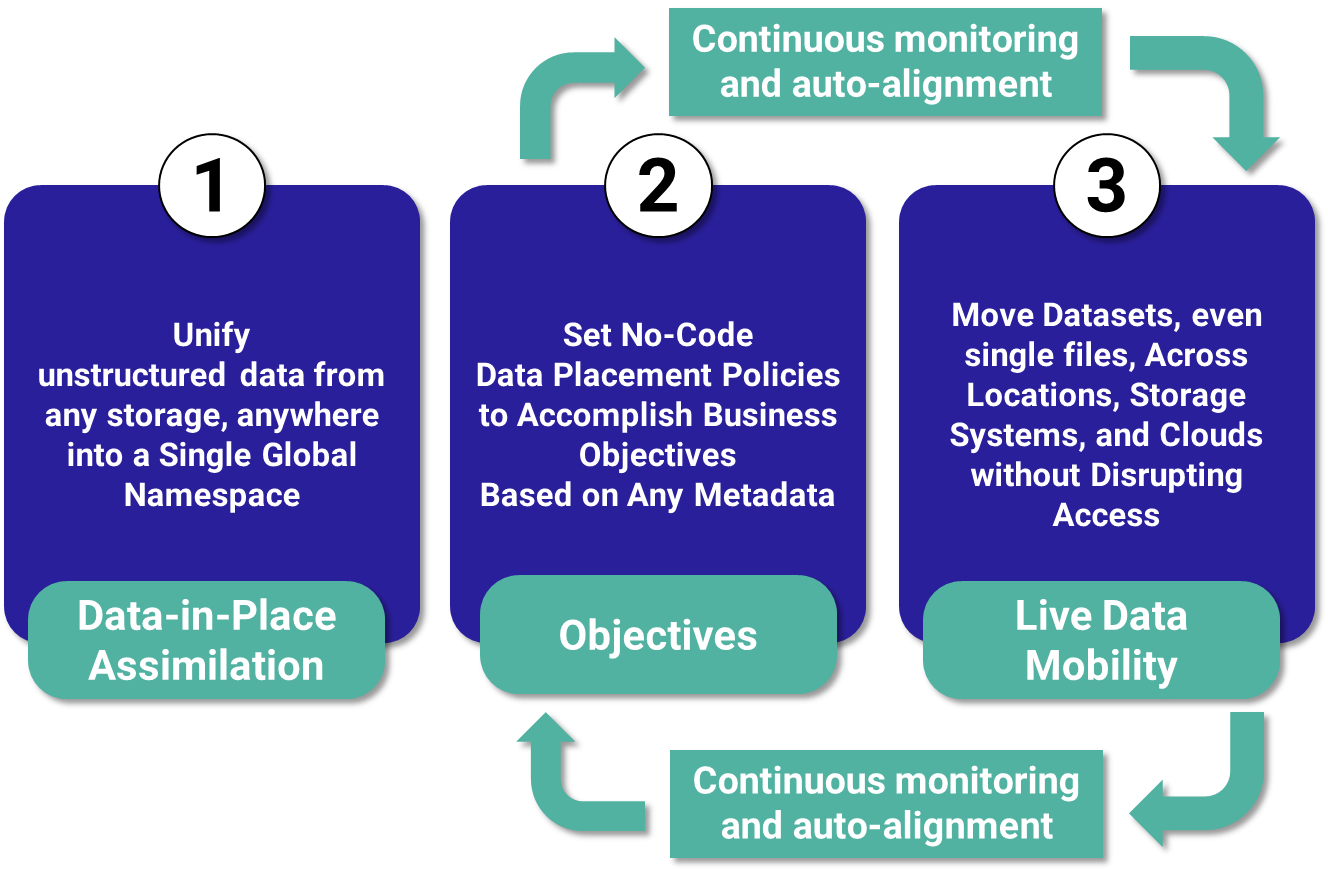
Hammerspace Data Orchestration Framework
Legacy Data Management Approaches are Too Complex and Not Declarative in Nature
Data management policies tend to be reactive. They are not “declarative” in nature, and even creating a simple policy like replicating data can take many lines of code in legacy storage and data management tools.

Hammerspace Objectives are Different: Set “No-Code” Policies Using Plain-Language Business Rules
With Hammerspace objectives, administrators can simply declare what outcomes (or “objectives”) are desired using plain language business rules, then Hammerspace’s software will achieve it.
Administrators can specify objectives with simple, single-button click options as shown below, or you can build your own objectives using simple IF/THEN statements using a GUI policy builder, or via API.
You can leverage any metadata, including standard POSIX metadata and custom metadata, as the basis for the objectives.
Objectives can be used to automate data management, data movement, and even data protection. For example, specifying that a particular share should have five 9’s of availability, or that a specific directory should always be mirrored.
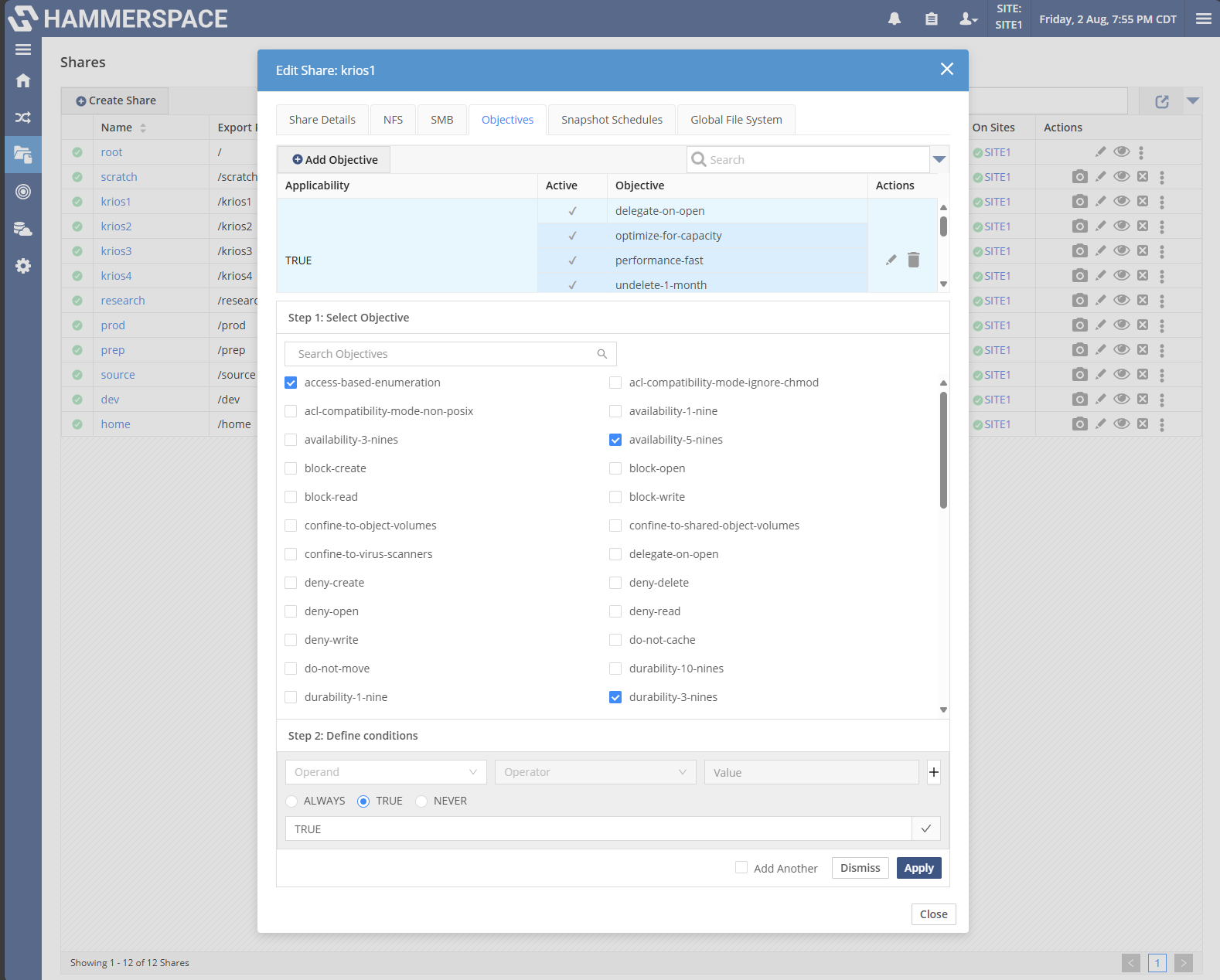
What Will You Use Objectives to Achieve?
Our customers use objectives to automate data movement between sites, move data to the cloud for burst-to-compute, and to move data to lower cost tiers of storage based on data access rules.
And what sort of outcomes are they achieving?
- A multi-national VFX company saved millions of dollars in cloud compute costs by using objectives to orchestrate data to lower-cost cloud regions.
- An aerospace company saved over $1M in NAS costs by using objectives to tier infrequently accessed data to lower-cost cloud storage.
- And a leading online retailer saved $600K in annual administrative costs by using objectives to automate the data movement between legacy storage systems and new storage systems in a different data center.
Ready to take the next step?
Get started today by taking a self-guided tour in a Hammerspace Virtual Lab, schedule a demo with your local account team, or get a trial license to deploy Hammerspace in your own data center or on the cloud platform of your choice.